Christmas, 1863

In 2017 I set myself the task of rehousing and cataloging the Francis B. Fay papers in our collection. Francis B. Fay was one of Southborough’s more remarkable native sons, who among other notable deeds donated the money to start our  library, which for many decades bore his name. But, I digress… back to the papers.

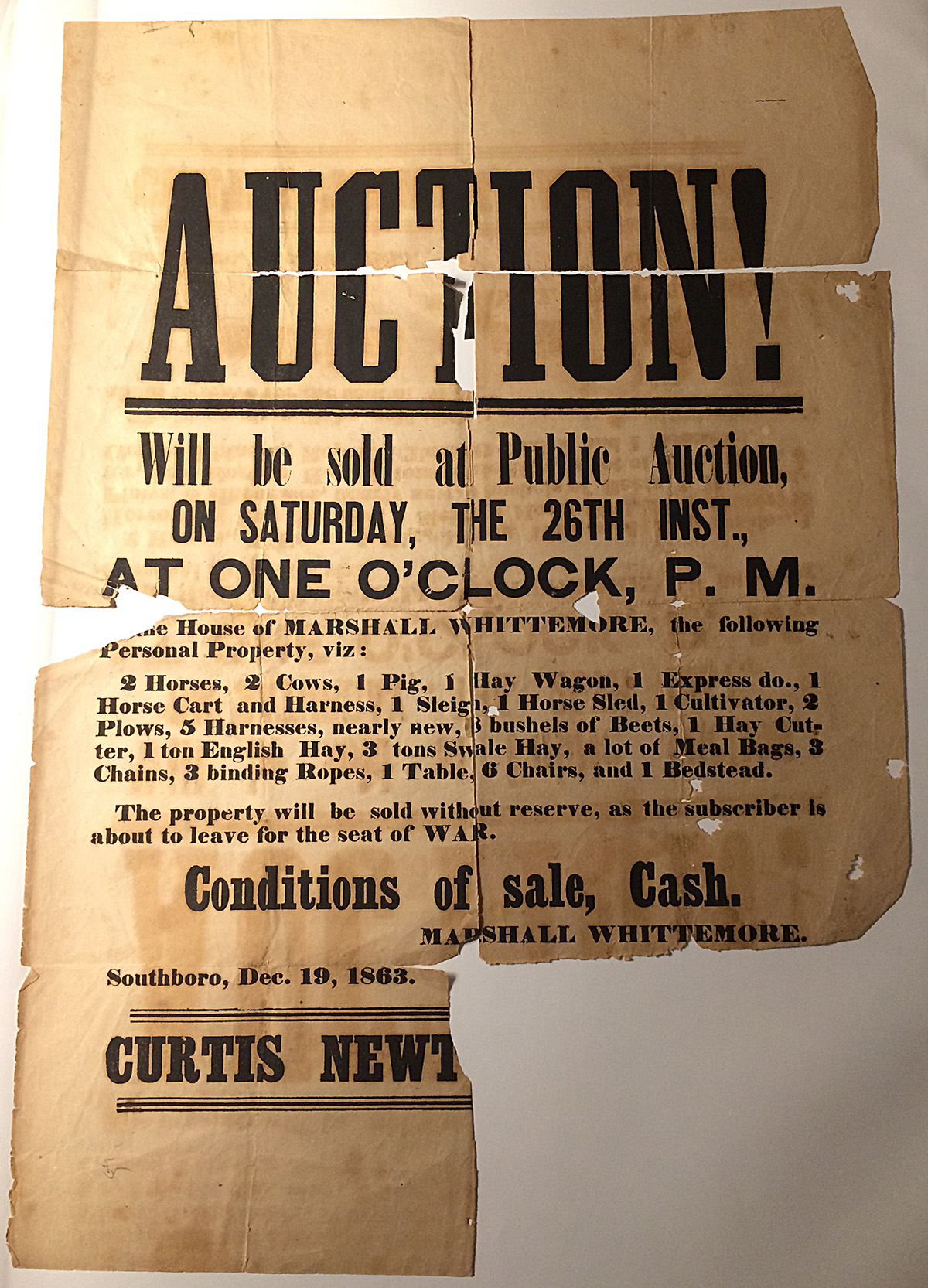
Cataloguing is not exactly a mile-a-minute roller-coaster ride of fun. It can be tedious, because there is a lot of minutia involved, but it’s critical if we really intend to take effective stewardship of our Southborough history. Most of the Fay papers were pamphlets of one type or another — very early sermons (some dating back to 1820), political tracts, speeches, and various other bits and pieces saved during a productive life of public service spanning 7 decades. But tucked away in one of these pamphlets, carefully folded up but literally rotting away with age, was the auction notice you see above. These broadsheets were never intended to be preserved; they were printed on the cheapest of paper, and generally thrown away afterwards. But somehow this one survived, and despite its damaged state,  caught my attention because of the  line below “CONDITIONS OF SALE”:

“The property will be sold without reserve as the subscriber is about to leave for the seat of WAR.”

“The seat of WAR”  Wow!

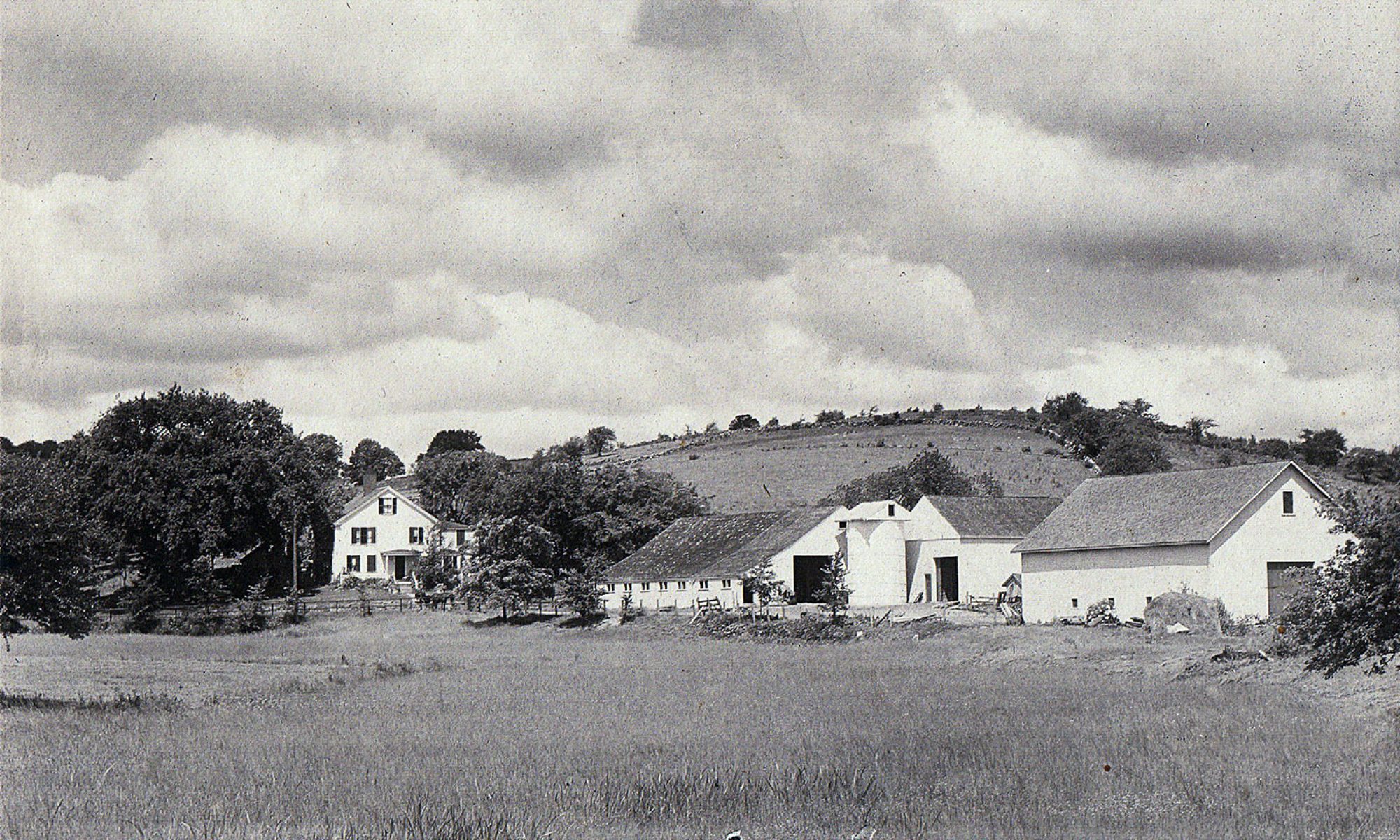
It’s not everyday you find a notice of someone auctioning their possessions in order to go fight in the Civil War. There are so many questions here. We know from the historical record that Marshall Whittemore lived on the corner of Boston Road and Framingham Road, in a Greek Revival cottage that is remarkably little changed. We know too he was married with children, and his profession was listed as farmer. So why was he selling his animals and farm equipment? To make provision for his family? How were they going to live while he was gone? What motivated him to enlist in the first place? He was not at all young — 41 — and the war had been raging for over two years. Something, though, prompted him to sell his precious goods the day after Christmas, and shortly thereafter, leave his home, wife, son, and daughter to fight for the Union.

Can you imagine how difficult that parting must have been? Heading off in a cold, dark December to god-knows-what fate?

Fortunately, thanks to other records in our collection, we know that our story has a happy ending.  Marshall Whittemore, now a private in a heavy artillery regiment, survived the disastrous battle of Newport Barracks where Union troops were overwhelmed 3-1 by Confederate forces. At the conclusion of hostilities, he was mustered out of the Army, returning to farm and family in Southborough where he lived peaceably for decades. He died in 1902 and is buried in the Rural Cemetery.

So the historical record is all neatly tucked up, but it leads to a final nagging question: why did Francis B. Fay decide to save this seemingly random broadsheet? Were the two men friends? Friends of friends? Distantly related? Or did Francis Fay simply admire the courage of a man who sold his most precious possessions, left his family, and headed off to war with the courage of his convictions. We’ll never know, but it’s something to remember as we fuss with ribbons and wrappings, fret over last-minute shopping, fume over holiday traffic, and worry endlessly about menus and decorations, that once upon a time, in a Southborough long, long ago, a certain courageous man named Marshall Whittemore gave up his home and hearth at Christmas, so that we of future generations could enjoy ours.

Thank you, Marshall. Thank you indeed.

And Merry Christmas.
← Back to Southborough@300!

Just Another Random Day in 1742


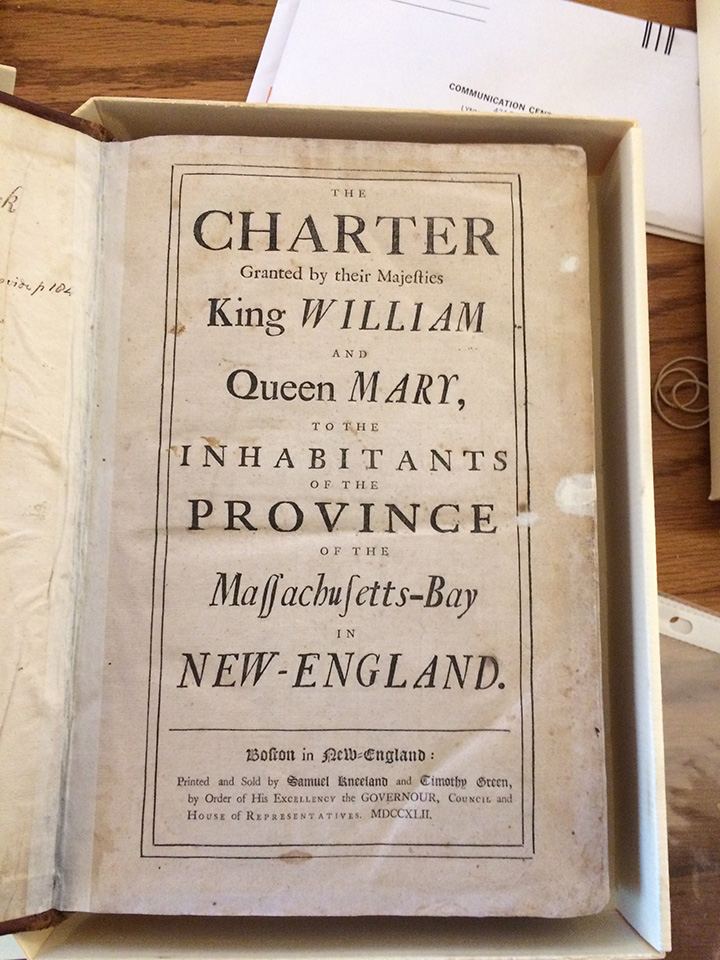
The more I get acquainted  with the Society’s collection, the more astounded I become. Here in tiny little Southborough, we have a world-class collection of items! Take the above, for example. This wonderfully preserved tome contains the Massachusetts Charter of 1691 that formally established the Province of Massachusetts Bay. Issued during the reign of William III and Mary II, the charter defined the government of the colony, whose lands were drawn from those previously belonging to the Massachusetts Bay Colony, Plymouth Colony, and portions of the Province of New York, and included all of present-day Maine, New Brunswick, and Nova Scotia! The book also contains all the subsequent laws governing the province up to the date of its publication, 1742 — which makes surprisingly fascinating reading, with all the little do’s and don’ts of life in Colonial Massachusetts.

My point in showing this to you today is to point that we have many volunteer opportunities that grant hands-on experience with incredibly historic material just like the charter. It’s a volunteer experience really unparalleled anywhere else, as most other institutions keep volunteers well away from the actual collections.

We are currently looking for volunteers to:

• help catalogue our book collection
• help organize and re-house our collection of objects
• help catalogue and re-house our paper and photo archives, and prepare this material for online presentation

No previous experience is necessary, other than a general knowledge of Mac operating systems, and a love of history.  If you’re interested in helping out, let us know.

← Back to Southborough@300!

The Boston & Worcester Trolley Air Line

I often think as I get in my car to travel the three or four minutes from my home to the museum, how long this trip would have taken a hundred years ago. Granted, I might have had a car in 1917, but more likely for Southborough, I would have had a horse, and saddling a horse and riding those few miles is a half-hour operation at best. Walking is about the same (you save the time of saddling and unsaddling) and biking was (and is) about 10 minutes, with one major hill.

Imagine then how thrilling it must have been to go from Boston to Worcester in 2 hours by trolley! Now of course, train travel had been around since the 1830s, but with limited local service. The Boston & Albany’s tracks on the border with Hopkinton were a major freight line, as well the route of the named ‘varnish’ trains (the Boston end of the famed 20th Century Limited passed daily through Southborough, for instance) headed for New York, Chicago and all points west.

But on a trolley, all things were local. You could get on and off at will, plus, during the summer months the cars were open-air, and the route truly scenic.  Speaking of the Southborough portion west to Worcester, the booklet below simply glows:  “This portion of the road, running through woods and fields, with fleeting glimpses of all that makes the New England landscape famous, give the tourist a trip long to be remembered.”  To the east of Southborough the route ran through the middle of today’s Rt 9, the old Boston Worcester turnpike, which by the time of the Airline’s construction in 1901, had been largely abandoned.  It must have been an incredibly beautiful trip through the rolling hills of unspoiled countryside and quaint little villages, and in fact the Airline ran special cars for “Trolley Parties,” which were popular day-long excursions in the early 1900s.

The booklet below has never to my knowledge been published online, and is here represented in full size: just click on the images to expand. The very rare fold-out birds-eye view map is truly one-of-a-kind. The booklet is not dated, but can be reasonably assigned to the very first years of the Airline, as the map doesn’t show the White City Amusement Park, which became a major attraction on Lake Quinsigamond by 1905.

This first-time publication is the product of the Society’s continuing  efforts to share our history widely and make our collections accessible to all, and a perfect example of why we need and value your continued financial support.  Donations are easy to make online: just click the button at the end of this post.  More pictures of the Airline are available HERE.

In the meantime, enjoy this long-lost booklet, newly restored to view.

Click on any image below to expand

The fold-out map below is 30″ long and 24MB. But, you can browse to your heart’s content. Maximize your browser size to fully enjoy!

Won’t you make more wonderful finds like this possible?
Donating online is quick, easy and secure. Simply click the donate button below:

← Back to Southborough@300!

Lost Southborough: 3 Historic Railroad Stations

Ever wonder why Southborough lacks an historic railroad station, especially given the beauties that still exist in Framingham, Ashland, Westborough, and many other points along the old Boston and Albany line?

Well, in fact, we once had not one, but three!

The first, on the branch Agricultural Line to Marlborough, stood on Main Street, in the empty lot west of Lamy’s insurance:

It’s unclear what happened to this beautiful Queen Anne Structure after service was discontinued in the early 30s. Perhaps some of our older members might remember when this building was demolished? How we could use this building now as part of a revitalized main street! Wouldn’t it have made a fantastic pub?

My understanding was that Southville Station, seen below in its prime, was abandoned, vandalized and eventually demolished in the early 70s, the low-point of historical preservation in Southborough.

However, its near twin Cordaville Station had a different fate. I had heard tell that it had been moved to New Hampshire, but I was never able to confirm that.


Until now! Sorting through our files as we move back into our museum quarters, I discovered this remarkable clipping. Ho ho! A clue!

So now, do you suppose our once glorious station still exists somewhere in Dublin New Hampshire? I’ve contacted the Historical Society there, and hopefully we’ll soon find out.

Regardless, the sad lesson to be learned here is that if you don’t value your historical structures, there’s always someone else that does…. much to the detriment of your own surroundings.

Moving forward, we need to guard our historic heritage much more actively, Southborough friends!

← Back to Southborough@300!