The Place to Be in 25!

We’re delighted to be able to share with you today a fantastic rendering of what our new large lecture and event space will look like:

The second floor gallery @Fayville. Click to enlarge.

In this visualization by the ever talented architectural artist Jeff Stikeman, we see the second floor gallery space set up for an arts and travel lecture on Italy. The participants have, of course, just finished a wonderful meal catered by a local restaurant , along with a flight of Italian wines to sample. (Hopefully everyone will be awake for the talk! )

This is just one of the many set ups the 1200 square foot space will be able to accommodate: small concerts, private events, art exhibitions and seminars are all possibilities on the docket.

Currently construction proceeds a pace, with a grand opening planned early in 2025.

Arrividerci!

William Washington – The First Free Black in Southborough

Since February is Black History Month, it seems appropriate to look at the life of William Washington who lived in Southborough over a century ago with his family.

In the midst of all the angst created by the “St. Mark’s Triangle” debacle, concern arose about how best to honor some of the marginalized people in early Southborough who might not have been buried within the walls of the Old Burial Ground. Of greatest concern was that all the tree removal and heavy construction work might have desecrated burials of the original inhabitants of the area, the Nipmucs. After much prodding. St. Mark’s School, the owners of the land, agreed to an archeological dig to discover whether there were any burials in the disturbed area. Around Labor Day, a limited dig was conducted. To the surprise of many, most of the dig took place on town owned land near the library rather than in the area owned by St. Mark’s that had been most disturbed, the site of possible native burials, and therefore of most concern. An important result of the dig is that some artifacts were uncovered as well as remnants of foundations of two buildings. After examining old maps and descriptions of the area, it seems probable that one of the foundations was a house owned by Joseph Burnett, located on what is now town library property. Further investigation revealed that house was once occupied by William E.J. Washington, the first free black man to live in Southborough.

The sections about the Washington family in Nick Noble’s Fences of Stone, A History of Southborough Massachusetts, paint a picture of a very industrious family that was integrated into the life of the community. Several of the Washington men were welcomed as members of St. Mark’s Church choir. The athletic talents of the oldest son, Edwin, were admired. We also learn that William, and then two of his sons, Edwin and Frederick, served as sextons at St. Mark’s Church. William worked at Deerfoot Farm before becoming steward at St. Mark’s School. After serving as William’s assistant for several years, Edwin replaced his father as steward when William moved back to Marlborough around 1904.

William became a bit of a legend at St Mark’s School when, in 1899, while on his rounds as night watchman, he noticed something strange about the lighting in the basement of the school room building. Investigating further, he discovered that there was a gas leak Unfortunately, when he opened the door to the basement, the lantern he was carrying set off an explosion and fire. Despite suffering serious burns, he alerted others to the fire and then tried to put it out with a hose he dragged to the cellar.  He had to be pulled out of the burning building by several St Mark’s students who then fought the fire until the fire department arrived. A grateful headmaster presented William with a check from the school to thank him for his heroic efforts.

It seems as if life in Southborough was quite good for the Washington family. St. Mark’s Church, St. Mark’s School and the Burnett family all played a role in making their lives in town pleasant. Their acceptance was certainly aided by the contributions the Washington family made to town life

Slavery was abolished in Massachusetts in 1783, so who was this man, William Washington, who after at least 110 years with no known blacks living in Southborough, moved with his family into a house in the heart of town? Where was he from and what happened to him and his family after they left Southborough?

William Everland Jacob Washington was born in 1859 in Newark, New Jersey to Thomas Washington and his wife, Martha King Washington. He had four younger sisters. Both of his parents were also born in New Jersey, in 1830. According to the 1860 federal census, Thomas was a steam engineer with a personal worth of $1000. The census also indicates that both of William’s parents could read and write. Records, with the notation “black” next to their names, indicate that Martha’s parents, Jacob King, a cooper, and his wife Mary Thompson, were married at the First Presbyterian Church of Newark in 1829.  Martha had six sisters. Both her parents were literate according to the census. Neither William nor his parents had ever been slaves. William was undoubtedly descended from slaves, but several generations back.

In 1879, William married Ella Mae Vanderzee in Kingston, New York. Ella was born in 1857 in Saugerties, New York to Thomas Vanderzee and his wife, Sarah Tuson. In the federal census, Thomas is listed as black and Sarah as mulatto. In another census, all the members of the family are listed as mulatto. Thomas was born in Green County, NY and Sarah was born in Dutchess County, NY. Ella was one of the younger of the 13 children in the Vanderzee family. Her father was a boatman on the Hudson River. In the 1870 federal census, she and her sisters are all listed as house servants while one of her brothers is a boatman.

After Ella’s marriage to William Washington, she worked for a short time as a servant for two white sisters, Eliza and Louisa Speer, in Newark, NJ. William and Ella’s first child, Edwin was born in Kingston, New York. They lived briefly in Brooklyn, NY before moving to Wellesley, Massachusetts where their second son, Frederick, was born in 1882.  Three daughters, Alma, Edith and Adaline followed in quick succession in 1884, 1885 and 1886 while they were still living in Wellesley. By February 1889 they had moved to Boston where their son Everland Beverly Washington was born. Their four-year old daughter Edith died in Boston in April of 1889 and five-year old Alma died a few months later.  Both girls died as the result of “weak hearts.”  By 1891, the Washington family had relocated to Marlborough where they welcomed another son, Leo, to the family. He died, of meningitis two years later. That same year, 1893, Ella gave birth to another daughter. Vera Louise in Marlborough.  In 1894, William and Ella, with their five surviving children, Edwin, Frederick, Adaline, Everland and Vera, moved into a house owned by Joseph Burnett, located on the grounds of the present-day library in Southborough.  At the end of 1894, twins, Amy Claire and Allan Gannett were born. In 1897, Esther Lucilla was born and the following year Victor Bexhill joined the family.

In 1900, Ella died delivering stillborn twins. She was 43 years old and was survived by 9 of the 14 children she had borne. She was buried in Marlborough alongside her son Leo and the stillborn twins. Within a few years of Ella’s death, William moved to a house on Hildreth Street in Marlborough with his five youngest children. His move was precipitated by the fact that the house in which they had been living in Southborough was being torn down to make way for the public library. In various documents William is listed as a stationery engraver or a watchman at a shoe factory while living in Marlborough.

The life of the Washington family in Marlborough took a tragic turn as the family was ravaged by tuberculosis. The first of the children to succumb to TB was nine-year old Amy Claire who died in December 1913. Seven months later, in June 1914, her twin brother Allan Gannett died at Lakeville Sanitorium. Seven-year old Esther Lucilla died in November 1914 at Boston City Hospital. Their father, William, who had gone to live in Everett with his married daughter Vera, died less than 3 months later, in February 1915, probably from TB, Victor Bexhill Washington was nine when he died in October 1915 at Lakeville Sanatorium.

William and Ella’s oldest son Edwin, who had married Frances Chestnut in 1905, also died at the Lakeville Sanitorium in 1916 at the age of 37, leaving his widow with three young daughters. His brother Everland died in October 1916, ten months after his marriage to Viola Jones.  He was 27.  Between December 1913 and October 1916, six of William’s children died from tuberculosis. Although William’s death certificate could not be located, it is probable that he also died of TB. During the same time frame that the Washington family lost six, possibly seven, members to TB, only five residents in the entire town of Southborough died of TB, one of them being Edwin Washington.

What became of William’s three surviving children and his three granddaughters, the children of his son Edwin?

William’s daughter Adaline moved to Boston where she became a nurse. She lived for many years in Boston and Malden. She never married. She died in 1970 and is buried in Everett alongside her father and her sister Vera.

Of the five youngest children who moved to Marlborough with their father after the death of their mother, Vera Louise is the only one who did not die from TB.  In 1914, she married Albert Lee Randolph at St. Mark’s Church in Southborough. She and Albert lived in Everett and Malden after their marriage. She had two sons and a daughter.  One of her sons died at age 11 when hit by a car. In the 1950 federal census, they had three wards of the state living with them. Vera died in 1985.

Frederick Tudor Washington. the one Washington son to survive the TB scourge, lived most of his adult life in Boston. He married Daisy Mainjoy in 1906. They had a son and a daughter. According to various federal censuses, he was a painter. Fences of Stone notes that for a while he had a band that played at some dance clubs.  The Echo of Their Voices, 150 Years of St. Mark’s School, says that he achieved his dream of becoming an Episcopal priest. He died in 1965.

William’s eldest son Edwin Washington, who had succeeded his father as steward at St. Mark’s School, died at age 37 leaving his widow Frances, and three young daughters. A fourth daughter had died in 1913 of whooping cough. Frances moved with her daughters to Westborough where she worked as a hairdresser. In 1929, she married Harry Elliot, a barber. He died three years later. Her oldest daughter Frances was married in 1928 to Raymond Neizer and moved to Salem. In a scenario eerily reminiscent of her mother’s life, Frances became a widow in 1932, left to raise three young children. Her sister, Ella V. Washington was married to Marceo Griffin in 1936. They moved to Florida where, in 1940, they divorced. She returned to Westborough, making it her home base as she traveled extensively throughout the world while working as an educator for organizations such as UNESCO. She died in 2003 at the age of 93. She is acknowledged by Nick Noble as a valuable source of information for his book, Fences of Stone. Edwin’s third daughter, Edith Marion never married. She died in 1978. Edwin, his wife Frances, and their daughters are all buried at Rural Cemetery in Southborough.

William and his family passed through Southborough’s history briefly, living here for just over a decade, more than a century ago. Their lives were beset by the deaths of children from childhood diseases, death in childbirth, and devastating losses from tuberculosis. Although these were not uncommon problems at that time, it seems as if the Washington family had more than their share of family misfortunes. We remember them as pioneers, the first free black family to live in town, but we also recognize them as survivors who continued to persevere and contribute to society even when the odds were against them.

 Some Sources:

 Fences of Stone by Nick Noble

The Echo of Their Voices, 150 Years of St. Mark’s School

United States Censuses\

Massachusetts State Censuses

Vital Records of Boston, Wellesley, Marlborough, and Southborough


Society to Design Digital Main Street History Walk

Dear Friends

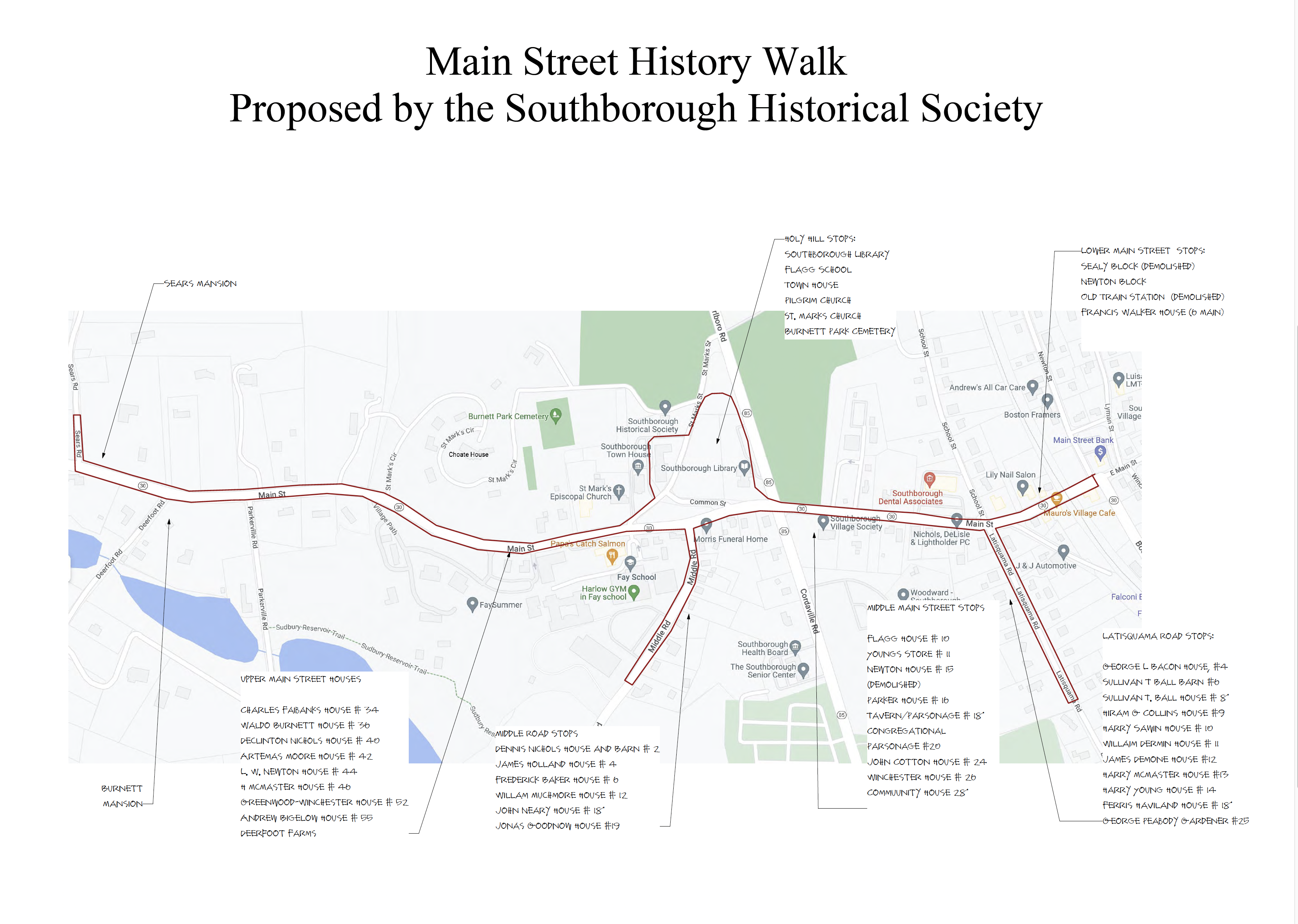
I thought I would take a break from Fayville Hall updates to let you know about another exciting program the Society has been working on over the last year: a new self-guided history walk for downtown.


click on the image to enlarge

The original conception for this tour was a more traditional post-and-sign route, similar to what has been done in neighboring Hudson and Marlborough. However, given the large number of stops and the primarily residential nature of neighborhood, this traditional approach presented problems. Thus, our proposed tour will be almost entirely digital, and can be started at any point along the map. Just pull out your tablet or phone, go to the proper web address,  push a button, and presto: images, text—and perhaps even audio—for each stop will pop up as you move along the route.

We’re currently in the process of adapting the map technology, and assembling the data for each stop. With a little luck, portions of the tour will be available this fall, with full completion expected by 2024.

Just another way we strive to bring your history alive!


On the Last Day of 2022

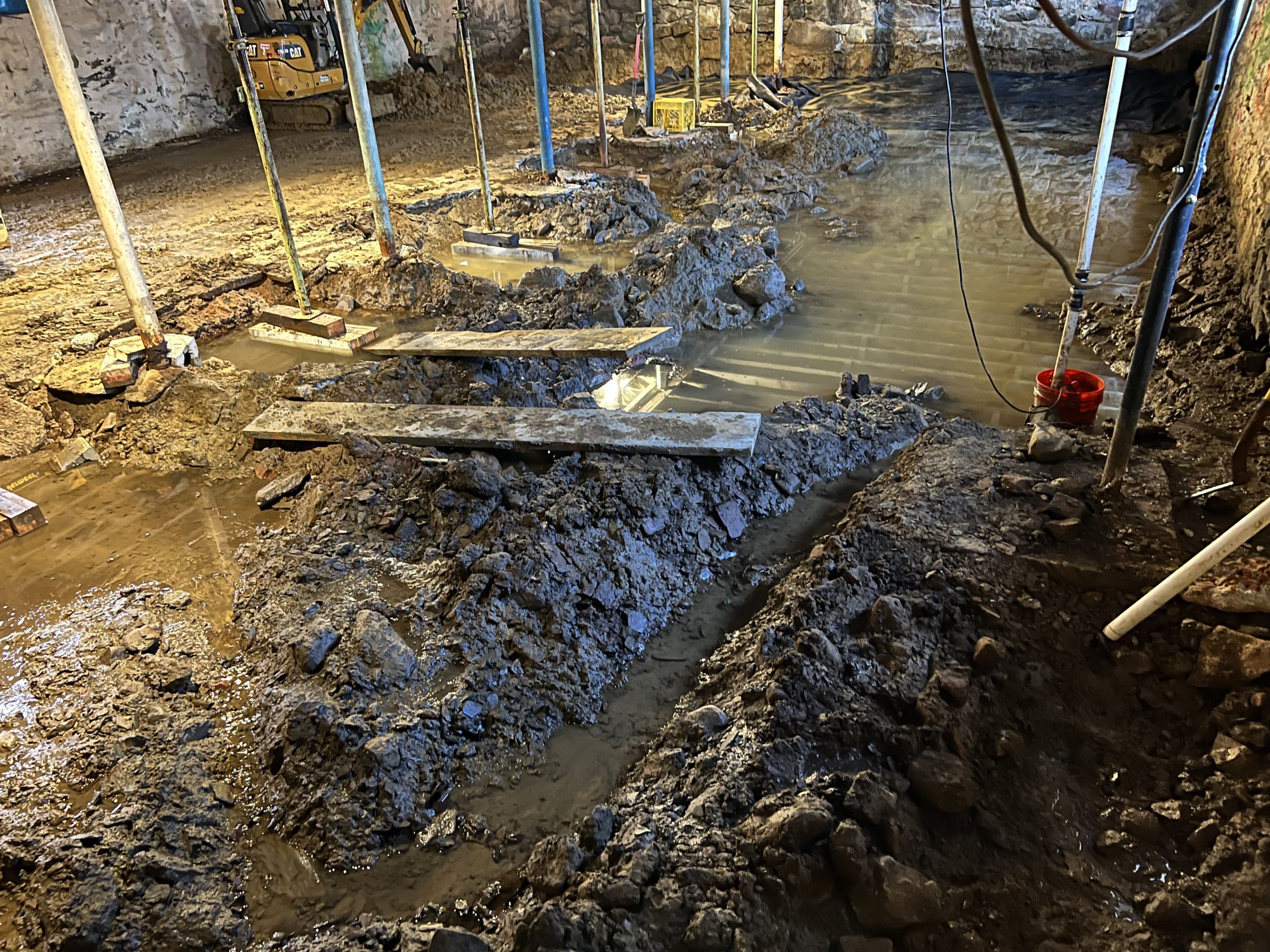
The basement of Fayville Hall, and the newly dubbed Lake Weishan

Dear Friends,

As 2022 fades to gentle whisper, I thought it a good time to give you a quick update on the Society’s progress. In short, our membership numbers continue to rise, our long-term plans remain sound, and our commitment unflagging!

How’s that for good news?

And—as you probably know if you have passed by the Fayville Village Hall lately—we have begun initial work to shore up the structure, and correct pressing water “issues” in the basement of our future home. It’s hard to believe from the photo above that this will shortly be our new classroom space, but it’s true. Once this urgent work has been accomplished, and after a return visit to the Planning Board to present some simplified site plans, we should be able to begin construction in earnest. We are still hoping for a phased opening in the fall of 2023, but that of course is to a large extent in the hands of the weather and supply chain gods!

There is no doubt that work on an historic building like this demands a real leap of faith. It requires trust in the craftsmanship of the past, as well as a real  vision of, and a fiduciary investment in, our shared future.  Since I came on board at the the Society after the disastrous 2015 flood, I have been reminded again and again of the commitment that you, our members—and of our fellow townsfolk in general—have shown to preserving our past and moving our joint endeavors forward.  You have indeed been asked to leap, and you have. As the clock slips towards midnight and 2023 beckons, I want to thank you all again for your faithful and continuing support.

From myself and the entire SHS Board, good health and godspeed in 2023.

Michael Weishan,
President, SHS


Fayville Hall Update

The Southborough Historical Society is delighted to announce it has reached a final agreement with Jon Delli Priscoli, the current owner of Fayville Hall, to acquire the property.

JDP, as Mr. Delli Priscoli is almost universally known, has agreed to donate the building to the Society for $100. Providing the Southborough Board of Selectmen release their right of first refusal, which will hopefully occur this week, renovations will begin right after Labor Day, as site plans and permits are already in place.

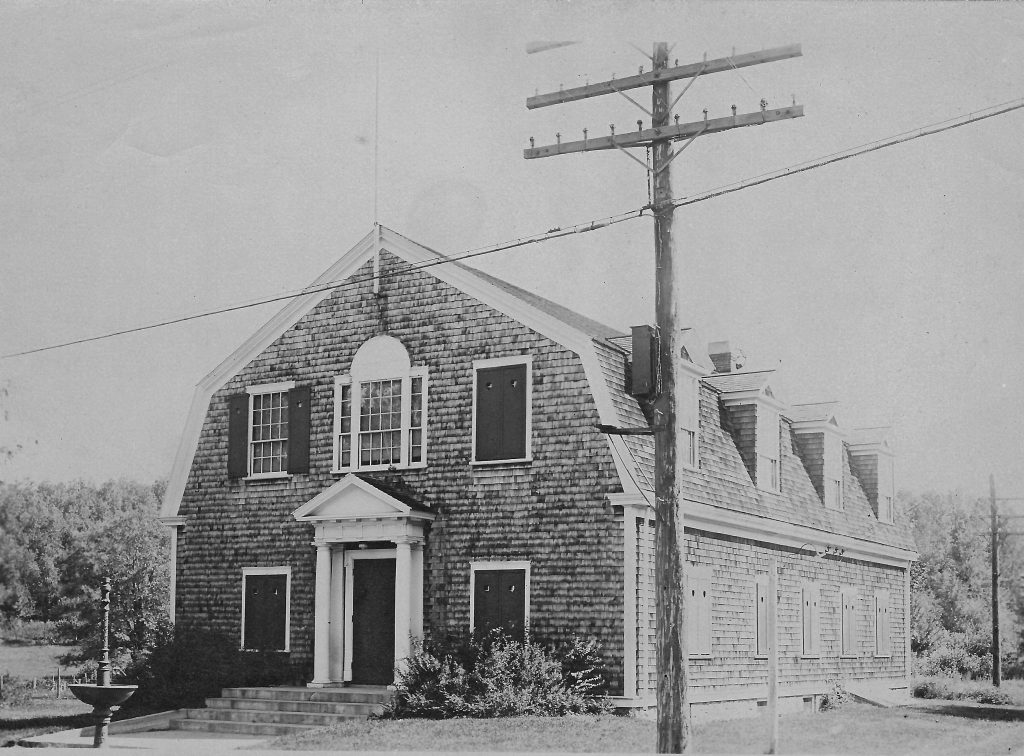
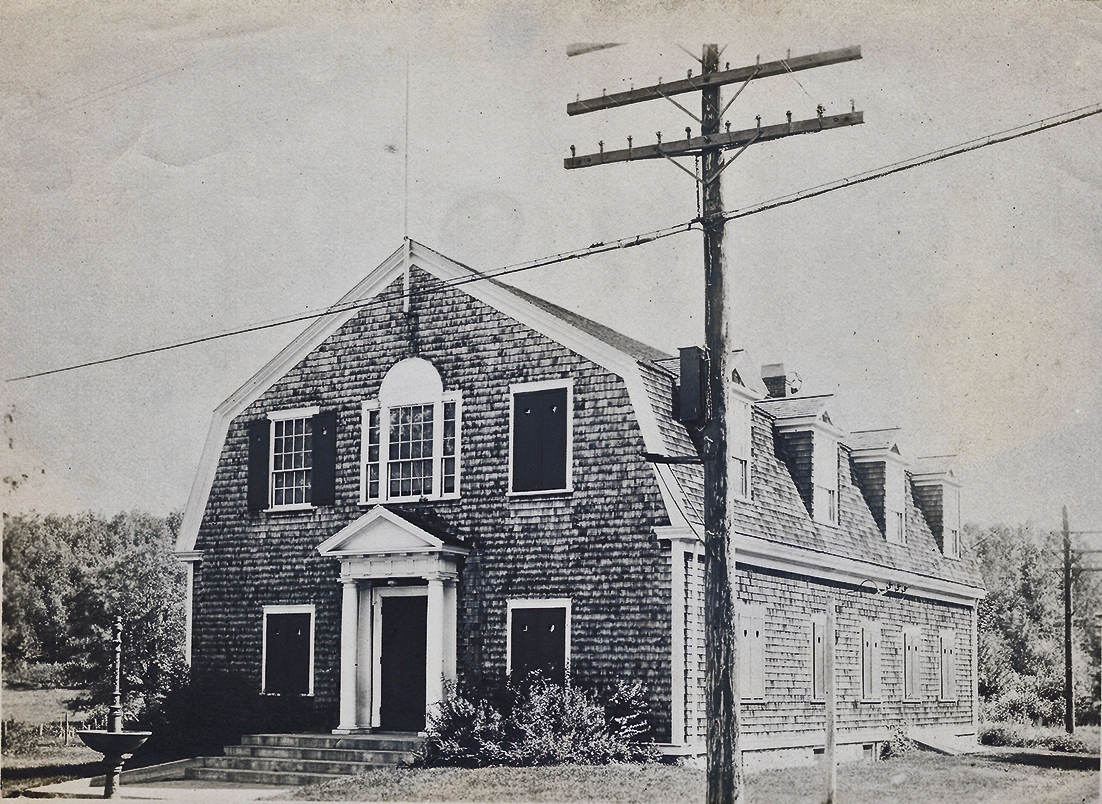
Fayville Hall, shown here about 1930, is about to return to its former glory.

Draft drawings of the interior reveal many features that will vastly increase residents’ enjoyment of the building.

The 2000 sq ft. basement will be entirely finished to include a catering kitchen and a “makers'” space that will allow for classes and workshops in the arts and crafts as well as mouth-watering culinary explorations.

The first floor, of the same size, will be converted into museum and exhibit space, and will be used to host lectures, events and other paying functions. The Society hopes to name this floor the Matison Gallery, after our late and beloved friend, Kate Matison, who worked so tirelessly over decades to preserve the history of Southborough, and who was the chief mover behind Southborough’s recent Downtown National Register District.

The second floor, again roughly 2000 sq ft,  will be converted into a state-of-the-art archival, research and office space to house the Society’s ever-growing collections.

The exterior of the building will be completely restored to its 1914 appearance, complete with cast iron entrance fountain. Once work is completed, a preservation restriction will be placed on the property, which will hopefully then serve as an historical anchor in a part of Southborough that has faced considerable development pressure.  Plans also being contemplated include hosting a small farmer’s market in the parking lot on certain Saturdays to allow local growers a place to sell their wares, as well as other outdoor events throughout the year.

Work is expected to take 9 months and cost 1.2 million dollars, with the goal of providing Southborough with a thriving new history and cultural center for the 21st century (and hopefully beyond!)

Southborough Historical Society to Acquire Historic Fayville Village Hall

https://southboroughhistory.org/wp-content/uploads/2018/04/2018.024.001-Fayville-Village-Hall-1.jpg
Fayville Village Hall  sometime in the 20’s. Note the iron fountain out front, which the Society hopes to replicate.

The Southborough Historical Society, Inc. is pleased to announce that it has reached a tentative agreement to acquire the former Fayville Village Hall for its new home.

The potential purchase was made possible through a combination of fundraising, sale of targeted assets, and the generosity of the current owner, Mr. Jon Delli Priscoli.

The exterior of the 1914 building will be restored to its previous Classical Revival glory. Inside, current plans include mixed gallery/commercial-event/concert space on the first floor, with offices and archival storage on the second. A fully finished basement will provide additional artifact storage, as well a small catering kitchen to service events. And, once renovations are complete, the Society will place a preservation restriction on the property—which currently has no demolition protection—to make sure this remarkable edifice remains standing for future generations to enjoy.

“This will be the beginning of a whole new era for us,” explained Michael Weishan, SHS President. “The town-owned Flagg School building has always been an awkward fit for the Society, and we have long since outgrown its capacities. Further, an architectural assessment report we commissioned  in 2021 revealed that the Flagg building is in need of a quarter-million dollars in urgent repairs. Rather than put money into a building we don’t own, we began looking at other options last year, and Jon was kind enough to work with us to make this happen.

“The Fayville Village Hall, which is three times the size of our current building, will allow us to create an entirely new local and regional history teaching center for adults as well as our school children, and equally importantly, will provide income-generating opportunities that will guarantee the financial viability of the Society into future decades.

“We are also hugely pleased to demonstrate our dedication to preserving historic buildings outside of the Main Street Corridor, in acknowledgement that our town of Southborough was, and is, comprised of four distinct villages, all equally in need of preservation attention.”

If all goes to plan, work will begin this fall, with an expected grand opening  in early 2023.

Another Astounding Defeat for Historic Preservation in Southborough

Selectman Andrew Dennington, center, about to axe free-speech in Southborough.

In another astounding defeat for historic preservation in Southborough, the Board of Selectmen, now dubbed the “Select Board” voted to renew the contract for Department of Public Works head Karen Galligan.

Readers will remember that this is the same Ms. Galligan who is under investigation by the State Inspector General’s office (along with town Administrator Mark Purple and former BOS chair Martin Francis Healey, who signed the proposal) after accepting funds from a 290K “Shared Streets” grant from the State for a “History Walk”—a plan they never intended to implement, as was later admitted. In the process, Galligan and the BOS came close to destroying, if not destroying, a potential burial site for Native American and early colonial settlers. The State investigation against Ms Galligan, Purple and Co.  is seemingly ongoing, along with a stew pot of past allegations against Ms. Galligan, ranging from potential graft to gross mismanagement to spraying illegal pesticides on wetlands.

(You can watch a short video shown at Town Meeting on this HERE. BOS proposals for St. Mark’s site were rejected almost unanimously by the voters with numerous rate payers of all political stripes standing up to call out the BOS for their duplicity.)

Still, it seems from tonight’s performance, that the lessons about the dangers stemming from BOS arrogance were not fully absorbed, especially by Mr. Dennington.

Dozens of people were in fact waiting in the wings to speak against Galligan’s renewal when Dennington, who is a law partner at Conn Kavanaugh,  decided to wield his litigation skills to silence his fellow citizens. In particular, one of our most active members, who had spent the better part of two days cataloguing complaints against Ms. Galligan, was completely shut down and no discussion occurred.

Dennington’s abrupt and uncalled for move to cut off debate was legal, but, to use a not so gentle yet accurate term—incredibly sleazy—especially when it violated the rights of so many waiting to weigh in on Galligan’s poor record and the damage she has done to the historic fabric of Southborough.

You can watch Dennington’s sad performance HERE.

It’s obvious from Dennington’s demeanor he was very anxious to cut off any further discussion. And in one slice, he kneecapped democracy in Southborough.

So why would Mr. Dennington, along with three other board members, rush to approve the reemployment of a DPW director (with a raise) who is under active investigation by the State for solliciting a “History Walk Grant”, who has been proved to be incompetent on numerous occasions, and who is roundly reviled by a large number of citizens who petitioned to have her replaced?  Is there something MORE to hide? Their action defies reason, unless there are other reasons…

There is obviously more to this story to come. Maybe what’s needed is a citizens’ petition to recall Karen Galligan. It would have no binding effect, but perhaps another public humiliation is what’s needed to get the BOS to act in our interests.

In the meantime, shame on you Andrew Dennington for using your legal skills against your fellow citizens, denying them a voice in their government.  And woe to the historic fabric of Southborough under your tenure.

(Full disclosure: I ran against Andrew Dennington two years ago, and was one of several whistleblowers in the recent disclosures about the St. Mark’s Triangle.)

** This post has been edited from the original to further detail Galligan’s role in harming historical assets & and SHS response, in answer to a private letter sent to the SHS Board from Andrew Dennington claiming: ‘Frankly, I think that topic [Galligan] has only a tangential relationship to an actual historical preservation topic.”

We’ll let you decide that, readers. Godspeed!


Please Come to Town Meeting Tonight!

Ladies and Gentlemen

A quick reminder that we need your support at Town Meeting tonight. There are a number of very important issues on the ballot that affect preservation issues in Southborough (not to mention your pocket book!) among them articles to prevent the BOS from further desecration of the area around the Old Burial Ground; an article to form a PILOT committee, which might help slow the creeping gobble of historic properties by the private schools; and other measures tangential to good preservation policy, like an article that for the first time would allow for the recall of elected officers in Southborough.

Town Meeting is our one chance a year to express our opinions, and considering that our property taxes are about to take a huge hike upward, now is the time to have your voice heard as to how that money is spent.

Remember, the meeting this year is at Algonquin High School in Northborough., 6:30 PM

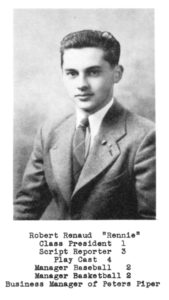
Robert L. Renaud (1925-1945) – He Lived & Died by the Words of His Graduation Speech

Robert L. Renaud  (1925-1945)

When you have an interest in history, sometimes a phone call can send you down a rabbit hole trying to find any information available about someone’s life. That is what happened when I got a call from Martha Boiardi asking if the Historical Society had a photo of Robert L, Renaud, a young man from Southborough who died in World War II.  A person in Amsterdam is trying to keep alive the memory of Americans who died fighting to free Europe, and had Robert Renaud’s name, a bit of information, but no photo. He had contacted Martha because she had posted the photo of Robert Renaud’s grave on Find-a-Grave. The internet does provide interesting ways of connecting. Martha’s request set off a search for a photo for the memorial in Amsterdam, but it also made me think that perhaps we here in Southborough should learn a little about this young man.

Robert L. Renaud was born in Hudson on June 30th 1925, the only child of Anna Salo, a Finnish immigrant, and her husband, Charles L. Renaud. The Renaud’s lived on Lincoln Street in Hudson.  Robert’s father worked at a shoe factory in Marlborough. His mother worked in Hudson for the Apsley Rubber Company which made gossamer, or rubber, clothing. According to the 1930 Federal Census she made tennis shoes.

The Renaud family moved to Southborough sometime after 1935. Charles, as did so many others in town, worked for Deerfoot Farm. They lived on Newton Street, so it is probable that he worked at the sausage factory. Robert excelled while attending the Southborough schools. At Peters High School he was president of the freshman class, managed the baseball and basketball teams during his sophomore year, was in the senior class play, and wrote for several school publications. Robert was salutatorian of the Peters High School Class of 1943. At graduation in June of 1943, he addressed his 19 fellow graduates, saying “Other years graduates have pondered over what careers they would follow, but this year we have only one choice, for all of us will have the same career – defending our own America against the aggressors who would rob us of the freedom guaranteed by the United States of America.” After summarizing the accomplishments of the “Builders of America” Robert concluded with the words “All of these men and many others, too numerous to mention, have been the builders of America. We wish now to preserve their work by defending America now and by giving to all future Americans the right to life, liberty, and the pursuit of happiness.”

These were not empty words to Robert and many of his classmates. Robert enlisted in the Army Air Corps. By the fall of 1943, Robert was in South Carolina at Erskine College as part of one of the special training programs at colleges around the nation that produced “ninety-day wonders,”   officers trained quickly to fill the ranks of the rapidly expanding armed forces. He was commissioned a 2nd Lieutenant upon completion of the training. After additional training in Nashville, Tennessee, he was stationed in England as a Navigator attached to 452nd Bomber Group, Heavy, 728th Bomber Squadron.

The people back in Southborough and at Peters High School followed his military career and that of many others. The high school publication had a section entitled Alumni News, most of which was filled with news from the young men in the service. Among the names which appeared were names still known in town: Bartolini, Noborini, Salmon, Maley, Finn, Staples, Bagley, Woodward, and Renaud. Robert sent home several articles to the high school publication he had headed while a student. The articles reflected his interest in the aircraft that played such an important role in the war. In an article that he authored, entitled “The P-40 Defends Itself,” he assumed the identity of the oft maligned P-40 fighter plane, and pointed out the P-40 was used in all theaters of the war. Another article that Robert shared was authored by Keith Ayling, and told the story of Reginald Mitchell, “The Man Who Saved Britain, the Creator of the Spitfire.” Robert seemed determined to make the people back home aware of the important role that air power was playing as the war unfolded.

2nd Lieutenant Robert Renaud was the navigator on board a B-17, part of the 728th Bomber Squadron, 452nd Bomber Group. On April 7th, 1945, his plane took off from Deopham Green, Norfolk, England on a mission to Kaltenkirchen, Germany, site of a Luftwaffe airbase. Before reaching its target, the plane came under attack by Messerschmitt 109 fighter planes that succeeded in disabling it and ultimately, according to other pilots, caused it to split in two and explode. Only two parachutes were seen. Seven of the ten crewmen, including Robert L. Renaud were listed as killed in action. Robert was two months shy of his twentieth birthday when he died.  On May 8th, 1945, just a month after Robert’s death, Germany surrendered. The 452nd Bomber Group played a key role in bringing about that surrender.

By the time of his death, his parents, Charles and Anna, had moved back to Hudson. It was there that they first received word that their only son was missing in action and later, confirmation that he had been killed. Robert’s grave is in Rural Cemetery here in Southborough, the town where he had spent much of his childhood. His father, Charles, died in 1992. His mother, Anna, died in 1995. They are buried alongside their son at Rural Cemetery.

We remember Robert L. Renaud on this, the 77th anniversary of his death.

Many thanks to Martha Boiardi whose phone call initiated the search for a photo of Robert Renaud and set me off on a path to learn more about him.  Martha also shared the information she had been able to uncover. A huge thanks to Patti Fiore who helped me find and dig through the many Peters High School publications where we found the photo, information, and some of Robert’s writings. She also worked her magic to make the photo as clear as possible.


What the Burial Book Reveals about the Irish by Sally Watters

As our nation engages is a tug of war about what our history is and what should be taught in schools, perhaps we can learn a lesson by looking at a small portion of the history of our own town. Some Americans today are trying to ban teaching lessons that reflect badly on their ancestors and I am sure that we would like to think that the bucolic town of Southborough’s history does not include any of the uglier chapters of the country’s past. What began as a quest for the identity of a girl named Martha buried in the Old Burial Ground ended up as a hunt for more information about Irish immigrants in Southborough, and unearthed the prejudice that manifested itself in Southborough in the nineteenth century.

There is a marker in the Old Burial Ground for grave 74 that merely says Martha. Members of the Historical Society have long wondered who Martha was. Our only clues were the people buried near her, but we could establish no definitive connection to any of them. Knowing there was a Burial Book that meticulously recorded deaths and burials in Southborough from 1794-1862, I began the pursuit of the death of any Martha during that time span. I realized that the time period 1727-1793 was not included in that source, and that since the Rural Cemetery opened in 1842, most burials after that date would not have been in the Old Burial Ground. After cross checking all the recorded deaths with tombstones in the Old Burial Ground and burials in the Rural Cemetery. I was left with three possible women named Martha in the Old Burial Ground who are unaccounted for. Uncertainty remains as to Martha’s last name. The Old Burial Ground is the resting place of all three of these Marthas, but does the stone belong to one of them, or to a Martha who died before 1794 or after 1862?  There are over six hundred unmarked graves in the Old Burial Ground. To further add to the mystery, Martha’s stone was carved by James O’Connor who was active carving stones between 1870 and 1902. Was the stone a late addition or was Martha one of the few people interred at the Old Burial Ground after 1862, the last year for the Burial Book I was using?

As often happens when doing historical research, it is easy to go off track. The Burial Book frequently has additional information beyond just the name of the deceased and the dates of death and burial. Sometimes the cause of death is included. If the deceased did not die in Southborough, but is buried here, the place of death is included and conversely, if the person died in Southborough but is buried elsewhere, that information is also included.

Starting in 1845, the effects of the industrial revolution and immigration began to be reflected in the Burial Book. The railroad had reached town by then. On November 11th, 1845, the railroad claimed its first known victim in Southborough when David Melison was “killed instantly by cars running over him in Southborough.” He was buried in Hopkinton. The Burial Book notes that his family was in Cambridge, Vermont. He would not be the only victim of the early railroad. On October 2, 1851 an “Irishman, name and residence unknown, was killed by the cars at Cordaville.” He was buried in Roxbury. Three weeks later, Mary Jane Mulligan, age 3, daughter of Thomas Mulligan, Irish, was killed by the cars at Cordaville. She was buried in Hopkinton. On November 14, 1851, Pamela Morse, age 59, was killed by the cars at the Depot. Lois Wallace, 66 was killed by the cars in Southborough on June 20, 1862. We know that fatalities on the railroad tracks have continued to occur into current times, but fortunately at a lower rate than in the early years of the railroads.

Not only did the railroad begin to make an appearance in the Burial Book, but starting in 1847 the word Irish begins to be used beside the names of some of the deceased when James Murrer, Irishman, drowned. He was buried in Worcester. On June 29, 1851, Luke Brady, Irishman, drowned in Cordaville. He was buried in Westborough. In 1852, three people named in the burial book were identified as “Irish.” Two of them were buried in Worcester and one in Hopkinton. On March 3, 1853 the two-year-old son of James Delling, Irishman, died. He was buried in Hopkinton.  Three more people were identified as Irish in 1854 and were all buried in Hopkinton. In 1855 Marie Carter, age 14, died in a fire at Cordaville factory, one of three people identified as Irish to die that year. She and one of the other Irish were buried in Hopkinton. The third was buried in Boston.  The following year, on June 29, 1856, Mrs. Ellen Brock, Irish, was killed at Cordaville along with her two-year-old daughter and the following day, Mrs. Lynch, Irish, was also killed at Cordaville. The Burial Book does not specify how they were killed. All three were buried in Hopkinton. What is very evident from the Burial Book is that the deceased who were Irish were being singled out with a label of national origin that was not deemed necessary for the other people who had died. It also is obvious that those who are identified as Irish are not buried in the Rural Cemetery in Southborough. Most of them are buried in Worcester, Westborough, and Hopkinton. The late 1840s and the 1850s was the time of a large influx of Irish immigrants into the United States as they sought to escape the ravages of the Potato Famine. As is so often the case with the entry of people who are somehow different from those already here, there was fear of the unknown, in this case people whose Catholicism set them apart. The Federal Census of 1860 for the Cordaville section of Southborough shows many people who were born in Ireland with names such as Mulligan, Cleary, Dowd, Kelly, Murphy, Burns, Sullivan, and Fitzgerald. In the state census of 1855, most were listed as shoemakers, but by 1860, a lot were designated as mill operators. The people of Southborough may have welcomed the Irish to town to work in the new mills and factories, but they did not welcome them to share the Rural Cemetery as their final resting place in death.

As I examined the recorded deaths for 1862, I noticed that Patrick Cleary, Irish, was not listed as having been buried in another town. What had happened? The footnote provided a clue, noting that he had died in Manassas, Virginia. Another mystery opened up for me to explore.  Who was Patrick Cleary?  As I suspected, Patrick was in the Union Army during the Civil War. He enlisted in May of 1861, just a month after the outbreak of the war and mustered into Company K of the Massachusetts 13th Infantry on July 16, 1861. He saw action at Harper’s Ferry, Bolivar Heights, and Falling Water before becoming ill on the march from Winchester to Centreville, VA.  He died of pneumonia at a field hospital in Manassas Junction, Virginia. His body was returned to Southborough where he was interred at the Rural Cemetery.

What was Patrick Cleary’s connection to Southborough and why, with the Irish designation after his name, was he not buried in another town?  Patrick was born in Drohega, Ireland in 1841, the son of Edward and Catherine Carney Cleary, His name first appears in Southborough in the 1855 Massachusetts State Census, where he is living in Cordaville with his parents and four younger siblings. All the members of the family are listed as being born in Ireland except for three-year-old Edward who was born in New York. The next youngest child, six-year-old Monaca was born in Ireland. The family was in Southborough by November of 1851 when Edward Sr. was listed as a member of the Southborough militia. That same year, Edward Sr. ran a missing person’s ad in the Boston Pilot seeking information about his brother, “Patrick Cleary, a native of Killahara near Tipperary,” who had emigrated from Ireland circa 1838, first to NY and thence to Boston and had last been heard from in Worcester County. Any information about Patrick was to be sent to his brother Edward Cleary in Cordaville.  I could not find any evidence that Edward Sr. was ever reunited with his brother.

In the 1855 Massachusetts state census, Edward is listed as a shoemaker, but in the 1860 federal census, he is listed as a “pedler.”  The oldest daughter Mary, who would have been 18 in 1860, is no longer living with the family. His son Patrick, now 19, is listed as a bootmaker, and daughter Ellen, age 15, is a mill operator. Evidence points to Edward Sr. having died sometime in 1860. He was listed in the Federal Census of 1860 in Southborough, but in an application for a mother’s military pension filed in 1866, Catherine says she has been a widow for about six years and that her husband had died in New York. The death of his father, Edward Cleary, could help explain Patrick’s decision to enlist in the military the following year. As the eldest child, he had to help support his widowed mother and younger siblings.  According to Catherine’s testimony for the pension, Patrick had been helping support the family since 1857, when at age sixteen he went to work as a bootmaker. In 1866, Catherine was awarded a mother’s pension of $8.00 a month retroactive to 1862. In her testimony she stated that she owned no property and had no other income. Catherine had first applied for a pension in 1863, but the application was not approved at that time. Three acquaintances testified that Patrick had supported his mother since 1857, helping pay her rent, and that after Patrick enlisted, the town of Southborough paid her $3 a week until his death.  Both the 1863 and the 1866 applications stated that she was living in Philadelphia, Pennsylvania. Her 1863 application was witnessed by Mary Cleary and Nellie (Ellen) Cleary, Catherine’s two older daughters who were also living in Philadelphia.  By 1866, Ellen was married to John Swope. Both Ellen and John swear in a statement that Patrick’s father had died six years earlier in New York, and that his widow Catherine had not remarried. I could find no further information about any of Patrick’s siblings. No other member of Patrick Cleary’s family is buried in Southborough. His mother Catherine died around 1890

The town fathers reluctantly recognized the sacrifice that this young Irishman had made and allowed his burial in the town cemetery. He was the first Catholic to be buried in Rural Cemetery. The story has been passed down that at first he was interred in the paupers’ section of the cemetery, but some of his fellow soldiers were incensed by this slight and demanded that his body be moved to a different section of the cemetery. His body was moved, but remained without a marker until 1879 when a military marker was placed at his grave site. Life had not been easy for Patrick who came to the United States at about age 10, worked as a bootmaker, enlisted in the army early in the Civil War, and like so many soldiers in that war, died of disease, not on the battlefield. His death did begin to break down the unwritten rule that had kept Irish Catholics out of the Rural Cemetery, although it would be several decades before the gates were opened wide.

It seems hard to believe that prejudice against Irish Catholics was strong enough to keep them from being buried in the local cemetery. Should I, as the descendant of early Anglo settlers of this town, try to keep this history from being taught to spare myself any feelings of guilt? Should we ban the teaching about the inconvenient facts in our history, or is it an opportunity to learn about the damage that prejudice can cause?

On March 17th it is said that everyone is Irish when people celebrate St. Patrick’s Day. Fortunately for the Irish in Massachusetts, March 17th is also Evacuation Day, a holiday designated to celebrate the evacuation of the British troops from Boston in 1776. Like the early Christians who chose to shield the celebration of the birth of Jesus by observing Christmas during the Saturnalia festivities, the early Irish immigrants were able to celebrate St. Patrick’s Day under the cover of Evacuation Day. Today many more people are aware of St. Patrick’s Day than of Evacuation Day.

Happy Evacuation Day and Happy St. Patrick’s Day to all!

Thanks to Molly Leavitt for her help in the search for Martha and her knowledge about Southborough’s Civil War veterans.